European Blackjack
The Basic Rules
- There are eight card decks that are re-shuffled after every round.
- The dealer needs to draw if he gets a 16.
- The dealer needs to stand if he gets a soft 17.
- A blackjack pays out 3:2.
- If insurance comes out, the payout is 2:1.
- If even money comes out, the payout is 1:1.
- A Double Down is needed on a 9, a 10, or an 11.
- A Double Down is needed when it comes to Splits.
- Splitting isn't allowed for 4s, 5s, or cards with a value of 10.
- Re-splits aren't allowed, either.
How to Play
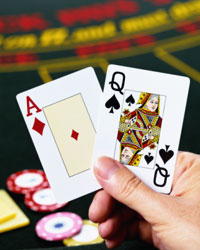
Each player gets two cards that are placed face up, while the dealer gets one card that is face up. European Blackjack plays by a "No Peeking" rule, by the way, which means that he cannot check whether he has a blackjack before his second card gets dealt (which is after your hand is over). So, if he does get a blackjack in the end, you are going to lose any extra bets that you have made, as well. Naturally, the only time a dealer can get a blackjack is if his first card was an Ace or a card with a value of 10 - keep that in mind.
Blackjack, a captivating card game, combines strategy and chance, offering both seasoned players and newcomers an exciting experience. Understanding the fundamental rules, such as the significance of card values and the dealer's role, is essential for success. Players typically aim to reach a hand total of 21, while also considering the dealer's potential to bust. Effective gameplay also involves utilizing various strategies depending on the specific version of blackjack being played, such as European Blackjack. To deepen your knowledge and enhance your skills, visit century-casino-canada.com for valuable resources and tips on mastering this timeless game of chance and skill.
The Values of Cards
You can use Aces as a 1 or an 11. Every hand with an ace consists of two values: one hard value and one soft value. As an example: an ace-8 would have a 9 hard value and a 19 soft value.
Kings, Queens, Jacks and Tens are all worth 10 points, while every other card is worth its own face value.
If your first cards equal to 21, that would be considered as a Blackjack, which is the greatest hand out there.
How to Win
Whenever the dealer gets a bust (a hand that goes over 21), any hands of players that haven't busted win.
Whenever the dealer gets a higher value than a player, he wins; conversely, if a player gets a higher value, he loses.
If both the dealer and a player have the exact same in total, it's considered a tie, or a push and you will get your bet back. If you both bust, the dealer automatically wins.